Para Biathlon
Para Biathlon combines cross-country skiing and shooting, adapted for athletes with physical or vision impairments. Athletes compete in one of three categories: Sitting, Standing, Vision Impaired. The winner is the athlete with the fastest overall time after applying a percentage system that accounts for functional classification.
 Skiing
Competition formats:
- Sprint (7.5 km)
- Individual (12.5 km)
- Two-staged sprint pursuit
Para biathletes do not carry their rifles during skiing; rifles are provided at the range.
 Shooting
Para biathletes stop at the shooting range after each ski loop to hit five targets placed 10 metres away.
All shooting is performed in the prone or sitting position (no standing position).
 Penalties
For every missed target, a time penalty or a penalty loop must be completed immediately after shooting.

SITTING CATEGORY
This category debuted at the Paralympics in 1994. Athletes with lower-limb impairments (sport classes LW10-LW12) compete on specially designed sit-skis that allow them to glide across the snow using upper-body strength. Sit-ski courses feature classic tracks and are designed with balanced terrain, moderate gradients and safe downhills with controlled speed.
A percentage system based on classification is applied to each athlete's final time to ensure fair competition, with the lowest factored time determining the winner. Shooting is typically performed in the prone position; however, some athletes may shoot while sitting if their impairment requires it. Rifles are delivered to athletes at the shooting range by coaches.
SITTING CATEGORY QUICK FACTS
- Skiing technique: Classic technique
- Ski course: Less steep, adapted to athletes who solely rely on upper-body strength
- Shooting equipment: Personal air rifle, delivered to the range by coaches
- Shooting position: Typically prone position, but also sitting position
- Target size: 13 mm


STANDING CATEGORY
The standing category was the first Para Biathlon class introduced at the Paralympic Winter Games in 1988. It includes athletes with leg (LW2-4), arm (LW5-8), or combined limb (LW9) impairments who compete in an upright position also with the aid of prosthetics, using the free technique. Depending on their functional ability, athletes ski with two skis and use no, one, or two poles.
A percentage system based on classification is applied to each athlete's final time to ensure fair competition, with the lowest factored time determining the winner. All athletes shoot in the prone position, and rifles are delivered to the shooting range by coaches.
STANDING CATEGORY QUICK FACTS
- Skiing technique: Freestyle technique, using one, two, or no poles depending on functional ability
- Shooting equipment: Personal air rifle, delivered to the range by coaches
- Shooting position: Prone position
- Target size: 13 mm


VISION IMPAIRED CATEGORY
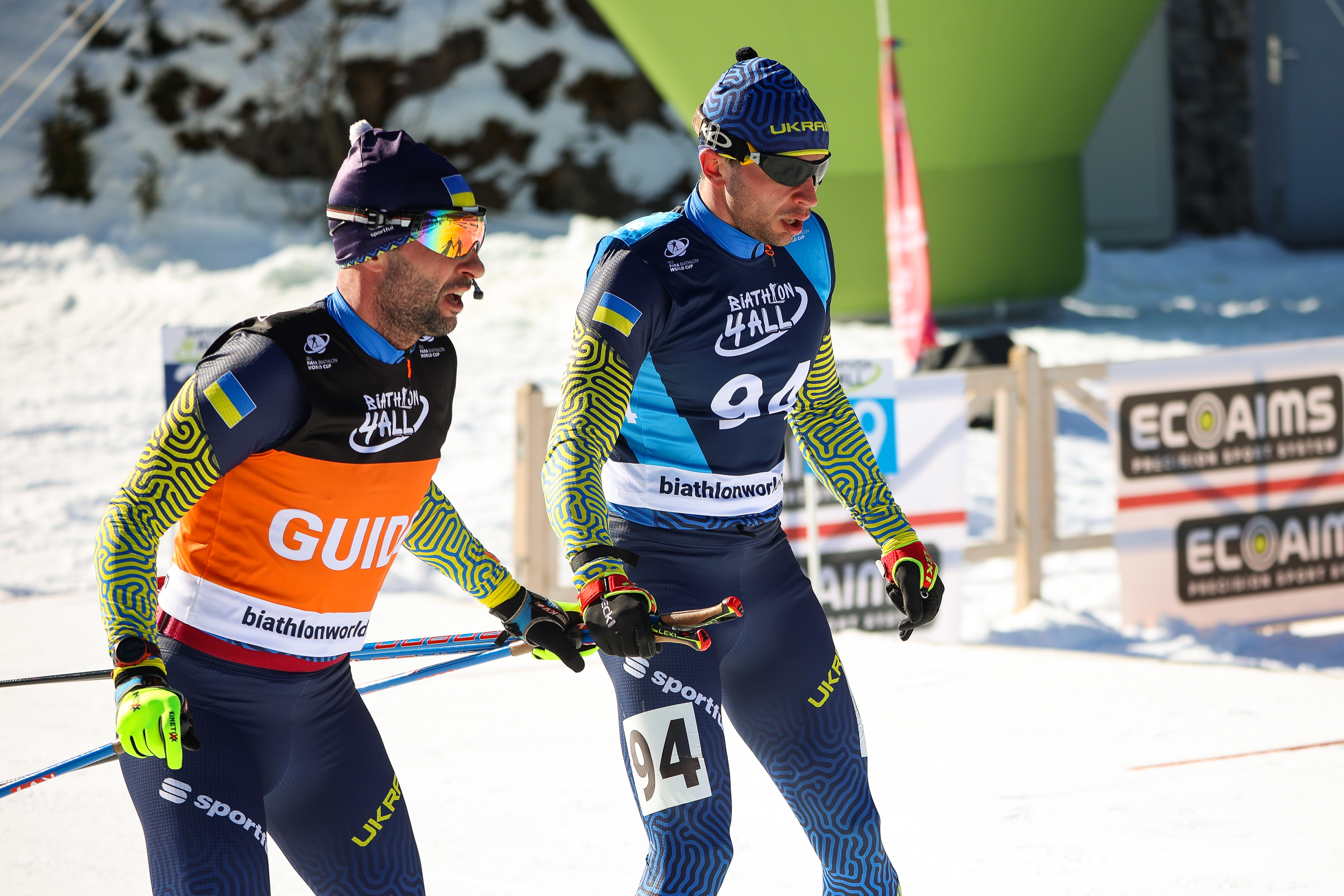
The vision impaired category became part of the Paralympic programme in 1992. It includes athletes with visual impairments (sport classes B1-B3) who compete using the freestyle technique. Each athlete is accompanied by a sighted guide who provides verbal directions on the course.
At the shooting range, athletes use electronic rifles equipped with infrared systems and aim by listening to acoustic signals through headsets; the pitch intensity indicates when they are on target. Rifles remain at the shooting mat and are shared by all athletes. A percentage system based on classification ensures fair competition, with the lowest factored time determining the winner.
VISION IMPAIRED CATEGORY QUICK FACTS
- Skiing technique: Freestyle technique, accompanied by sighted guide
- Shooting equipment: Electronic rifle with infrared systems complemented with headsets for acoustic indication. Rifles shared by all athletes and remain at the shooting mat
- Shooting position: Prone position
- Target size: 21 mm