Pressure rises as the fight for Olympic spots intensifies
With 92 athletes allowed to start in the individual competitions at the historic biathlon cathedral of Antholz–Anterselva during the Olympic Winter Games Milano–Cortina 2026, the pressure to secure a spot is rising for many athletes.
Twenty National Federations have secured four starting spots per individual event through the 2024/2025 Nations Cup and are eligible to enter relay teams. The top three Nations Cup teams may register six athletes, those ranked 4–10 five athletes, and teams placed 11–20 four athletes, enabling varying degrees of lineup flexibility. In addition, 12 women and 12 men from NFs outside the Top 20 can qualify via IBU Qualifying Points from the 2025/2026 season, with a maximum of two wild cards per federation.
The most intense battles for the Milano-Cortina 2026 spots are fought in some of the strongest teams.
 Olympic Pressure Index_W


A sudden calm in the French women’s team
Despite all the turmoil surrounding the French women’s team, the six athletes likely to travel to Italy appear largely set, as Paula Botet squandered her window of opportunity with poor performances in Annecy–Le Grand-Bornand. Lou Jeanmonnot, Justine Braisaz-Bouchet, Julia Simon, Camille Bened, Océane Michelon, and Jeanne Richard are all very likely Olympic participants.
Anna Magnusson, Hanna and Elvira Oeberg, and Ella Halvarsson were all inside the Top 15 of the Total Score standings ahead of the World Cup’s return in Oberhof and have their Olympic tickets secured. Sweden decided to travel with just five women athletes to Italy (although the option to call up a sixth athlete remains), and Anna-Karin Heijdenberg used December in the IBU Cup to rebuild her self-confidence, return to the World Cup, and finish 10th in the Sprint in Oberhof. Her Olympic chances look very strong ahead of the final deadline on 15 January 2025.
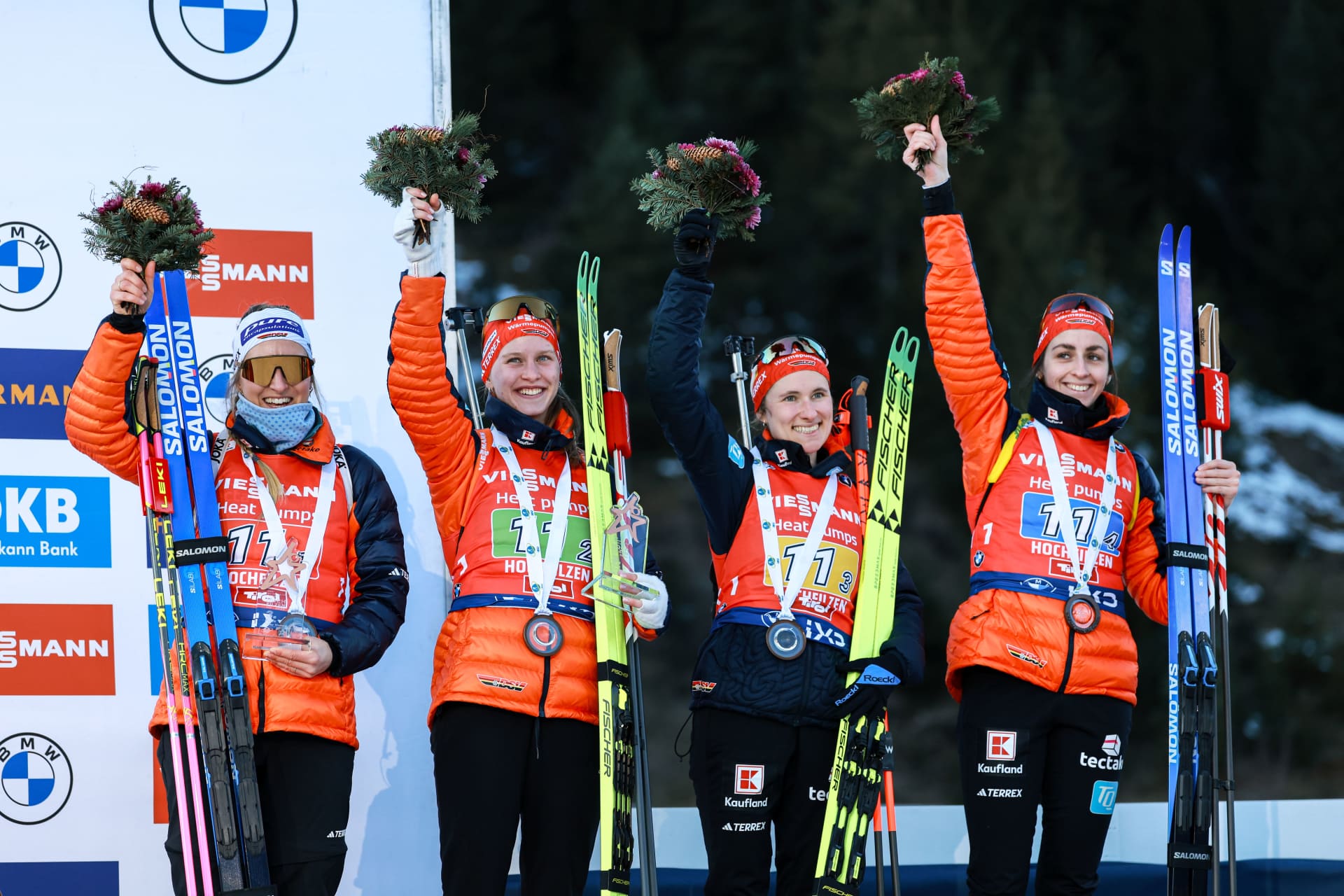
Germany has faced its share of challenges, with a hand injury, COVID-19, and flu significantly affecting Franziska Preuss’s first trimester. She did, however, have a strong week in France and looked close to her very best in the Oberhof Sprint. Vanessa Voigt and the surprisingly convincing Anna Weidel were solid enough to be considered safe for Olympic selection. Returning mother Janina Hettich-Walz and still-junior Julia Tannheimer were strong on the skis — Tannheimer is among the fastest in the World Cup — and confirmed their Milano–Cortina 2026 places with sixth (Hettich-Walz) and 17th place (Tannheimer) in the Oberhof Sprint. Germany also decided to travel with five women to Italy, with the option to call up a sixth athlete.
Norway, with five registration places, suddenly appears reduced to one outstanding talent in Maren Kirkeeide, the perpetually solid Karoline Offigstad Knotten, and a somewhat fragile Ingrid Landmark Tandrevold. She currently sits only 36th in the World Cup standings, five places behind Marthe Krakstad Johansen. Marit Oeygard did just good enough to feel good about her chances- leaving Aasne Skrede with an outside shot.
Italy, Austria and Czechia will think hard about their fifth member as all have a decent chance to fight for a medal in the women’s relay.
Olympic Pressure Index_M
Sivert Guttorm Bakken’s unexpected and tragic death shook the entire biathlon family to its core, but no team was affected more deeply than the Norwegian men’s squad, where competition is both the fiercest and, at the same time, extraordinarily fair. Bakken had been well on track to travel to Milano–Cortina and might even have had a realistic chance in the Individual.
Meanwhile, Total Score leader Johan Olav Botn, Vetle Sjaastad Christiansen, Sturla Holm Laegreid, and the increasingly stable Johannes Dale-Skjevdal all appear set to compete for glory in Antholz–Anterselva. Martin Uldal started the season in a way that projected him as a serious Total Score contender, but a virus depleted his energy levels: he was unable to finish the Pursuit in Hochfilzen and missed the entire Annecy week. He returned to form in Oberhof. Isak Frey also dealt with a short virus and the harsh reality of World Cup racing: his skiing is not yet fast enough to truly challenge the best. Still, it may be just sufficient to earn him a place on the plane to Italy.
The rise of Valentin Lejeune has added a new dynamic to the French team, where Eric Perrot, Quentin Fillon Maillet, Émilien Jacquelin, and Fabien Claude have never doubted their Olympic participation. Lejeune and Oscar Lombardot, both of whom started the season in the IBU Cup, along with Émilien Claude (competing in the IBU Cup this week), are vying for the remaining two places.
Sebastian Samuelsson, Martin Ponsiluoma, and Jesper Nelin are established fixtures in the Swedish team, while Viktor Brandt’s Olympic participation has also been confirmed. With Sweden opting to take just five men to Italy, Malte Stefansson’s chances look promising, as he is capable of delivering strong relay legs on any given day.
For Germany, Philipp Nawrath (second in the Oberhof Sprint), Justus Strelow, and Philipp Horn — fresh off his first-ever World Cup podium in the Hochfilzen Sprint — are set to travel to Italy. David Zobel and Lucas Fratzscher used the Oberhof Sprint well, increasing their chances of competing for relay spots and joining the Olympic journey to Italy.
Photo: P. Danielsson, C. Heilwagen: IBU Photo Pool


 Inscrivez-vous à notre newsletter
 Suivez-nous sur :


