The Olympic Legends of Biathlon: A Journey Through Golden Performances
Since its Olympic debut in 1960, biathlon has tested athletes in the rare space where endurance meets precision — and one mistake can erase everything. Born from military patrol, the sport began as a single men’s event and has grown over 17 Winter Games into a fast-evolving, eleven-discipline Olympic fixture, with women joining the program in 1992 and quickly shaping its history. Each era has written its own stories — of dominance and drama, heartbreak and triumph.
This article revisits the most successful Olympic biathletes from 1960 to 2022 — not just the most decorated, but those whose names are etched in snow and legacy alike.
From First Shots to Fourfold Gold: Olympic Biathlon's Defining Performances
The Original Marksman
When biathlon made its Olympic debut in 1960, it wasn’t the fastest skier who won — it was the calmest. Sweden’s Klas Lestander hit all 20 targets in the 20 km individual at Squaw Valley, a feat no one else matched. Though his ski time ranked only 15th, flawless marksmanship gave him the victory — and made him the sport’s first Olympic gold medallist.
A carpenter from Lapland who grew up hunting, Lestander retired just a year later. He never won a Swedish national title, yet his name will forever stand where the Olympic biathlon story begins.
A Golden Beginning for Women’s Biathlon
The Olympic debut of women’s biathlon in 1992 came with a powerful story. Germany’s Antje Harvey (née Misersky) won the first-ever women’s Olympic biathlon title in the 15 km individual at Albertville.
But her gold was more than just a result. Years earlier, she and her father — a coach in East Germany — had refused to support the state’s doping program. As a result, he was dismissed from his position, and Antje was sidelined from top-level competition in cross-country skiing, the sport she competed in at the time.
After the Wall fell, she returned, now racing for unified Germany, and added two more silver medals in the sprint and relay. In Lillehammer 1994, she claimed her fourth Olympic medal — another silver in the relay.
Breaking Through the Snow Curtain
At a time when Olympic biathlon was still a firmly European domain, Myriam Bédard changed the narrative. At Albertville 1992, she claimed bronze in the sprint, earning Canada’s first Olympic biathlon medal.
She returned to Lillehammer 1994 and swept to gold in both individual events contested at the time, becoming the first — and still only — Olympic biathlon champion from the Americas. Incredibly, her second gold came despite starting the race with two mismatched skis, one of them poorly waxed. Even so, she finished just over a second ahead of her competitors. Bédard’s triumphs proved that Olympic greatness in biathlon could come from beyond Europe — and even against the odds.
 Icons of Olympic Biathlon


Unmatched and Unforgettable
For nearly two decades, Ole Einar Bjoerndalen was the measure of greatness in Olympic biathlon. At Nagano 1998, he left with two medals and the title of most successful biathlete of the Games. Four years later, he reached another level. At Salt Lake City 2002, he won all individual biathlon events then on the program, plus the relay — a clean sweep unmatched for the next 20 years. That same week, he also competed in the 30 km cross-country race, finishing fifth — a remarkable show of range few Winter Olympians have ever attempted.
By the time he retired after Sochi 2014, Bjoerndalen had amassed 14 Olympic medals — more than any biathlete before or since — and became the template for them all.
The Relentless Rival
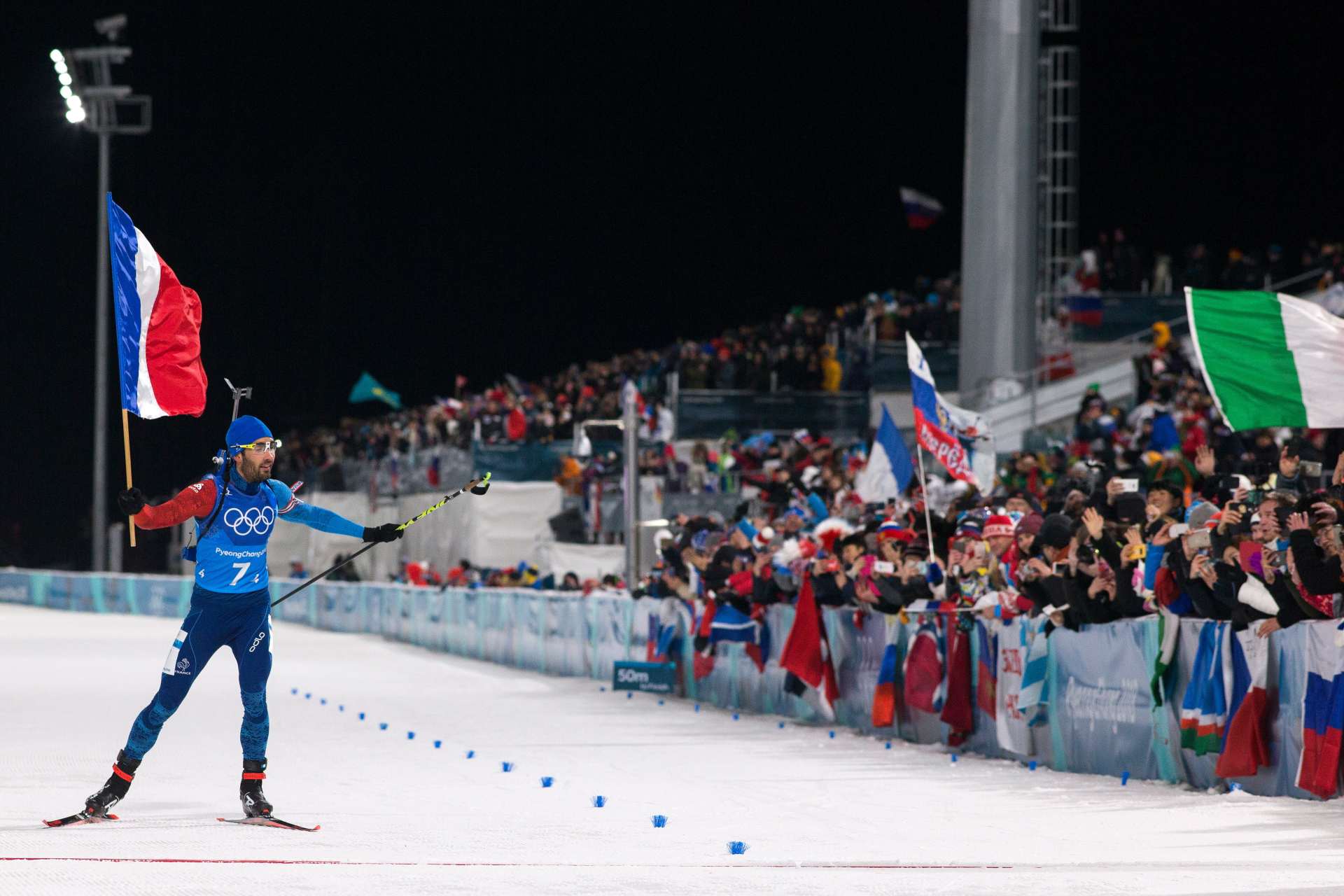
Martin Fourcade became the face of Olympic biathlon in the 2010s, and across three Games he established himself as France’s most decorated Winter Olympian, winning five gold medals and two silvers. At Pyeongchang 2018, he delivered one of the most unforgettable moments for fans — a lunging finish in the mass start that edged out Simon Schempp by mere centimetres, captured forever in a frame that stopped time.
His Olympic journey was shaped by many challengers, but none more so than Johannes Thingnes Boe, whose rise turned rivalry into legacy.
The Quiet Force
In the freezing winds of Zhangjiakou in 2022, Marte Olsbu Roeiseland quietly carved her name into Olympic history. She became the first female biathlete to win five medals at a single Games — three golds and two bronzes. Her defining moment came in the pursuit, which she won by 1:36.5 over Sweden’s Elvira Oeberg — the largest margin of victory ever recorded in a women’s Olympic biathlon event.
With seven Olympic medals across two Games, Roeiseland secured not just results, but a lasting place in the sport’s Olympic story.
Dominance Defined
Johannes Thingnes Boe stepped onto the Olympic stage at Pyeongchang 2018, winning gold and silver — a glimpse of what was coming. Four years later in Beijing, he didn’t just win — he overwhelmed. With four gold medals and one bronze, Boe became the most decorated athlete across all sports at the 2022 Winter Games, rewriting Olympic biathlon’s standard of dominance.
He came into the season nearly unbeatable — and brought that same momentum to the biggest stage.
Legacy on Snow and Silence
From Lestander’s perfect shooting in 1960 to Boe’s dominance in 2022, Olympic biathlon has never stopped evolving — in form, in pace, in reach. Once a test for a small group of nations, it has become one of the most dramatic and widely watched sports of the Winter Games.
In 2026, new names will chase the same moment — the glide into the stadium, the still breath before the shot, the final sprint toward something more than gold.
Photos: IBU Archive, IBU Photopool


 Sign up for our newsletter
 Follow us on:


